Codrel Sentinel
Giving AI coding agents and pull-request bots a living memory of fragile files, past failures, and repository risk.
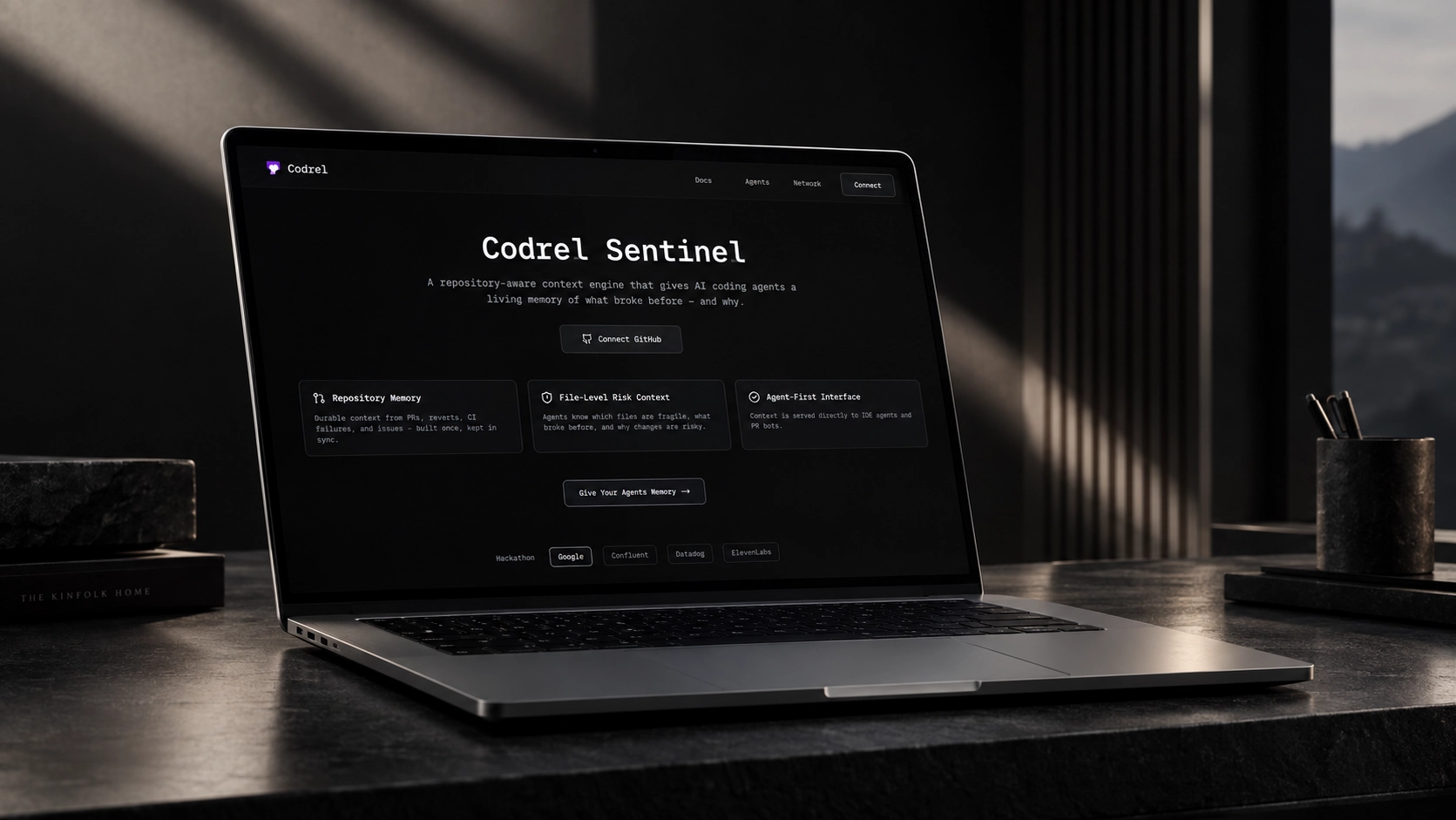
Repository history turned into active safety context.
The reasons a file is risky are usually buried across pull requests, failed CI runs, issues, and reverts. Codrel Sentinel converts those signals into durable repository memory that agents can query before they make a change.
An event-driven backend keeps that memory current, while a dashboard, pull-request bot, and agent-facing tools make historical risk visible at the moment it matters.
Safety signals across the delivery loop
- Repository history ingestion
- File-level risk analysis
- Kafka event backbone
- Historically grounded PR review
- Agent context tools
- Observability and critical alerts
Coding agents could see code, but not consequences.
Current source does not explain why a refactor failed six months ago, which files repeatedly break CI, or what conditions made a previous change unsafe. That institutional memory exists, but it is fragmented and invisible to automated tools.
The system needed to continuously ingest repository events, compress history into useful context, score risk at file level, and deliver the result without slowing the developer workflow.
- 1.
Failure history buried across repository systems
- 2.
Fragile files looking ordinary in current source
- 3.
Generic reviews missing historical context
- 4.
Safety signals arriving after a risky change
What We Were Really Solving
The core problem was giving automated developers memory, timing, and an operational sense of risk.
-
Recover institutional memory
Turn pull requests, failures, issues, and reverts into durable context.
-
Detect risk at file level
Explain which modules are fragile and what history made them so.
-
Intervene inside the workflow
Place grounded warnings in reviews and agent tools before changes land.
-
Keep the system observable
Track event delivery, analysis, retries, and critical failures in production.
An event-driven memory that stays current
Repository signals flow through a shared event backbone, allowing independent workers, observability, and agent tools to use the same evolving memory.
- 01
Observe
Git provider events capture pull requests, failures, reverts, issue activity, and repository changes.
- 02
Process
Kafka coordinates asynchronous indexing, analysis, retries, and continuous context updates.
- 03
Reason
Gemini compresses relevant history into explanations of fragile modules, prior failures, and risky change patterns.
- 04
Intervene
PR reviews, IDE tools, dashboards, telemetry, and critical voice alerts surface the right safety signal.
Memory embedded in the coding workflow
The product connects historical reasoning to the places where humans and agents review or produce code.
- 01
Initial repository analysis
Background workers build file-level context, hotspots, ownership signals, and historical risk when a repository connects.
- 02
Continuous synchronization
New pull requests, CI outcomes, reverts, and issues update the repository’s living memory through Kafka.
- 03
Historically aware review
The pull-request bot explains risky changes using relevant prior failures instead of generic lint-style warnings.
- 04
Operational visibility
A dashboard and Datadog telemetry expose system health, repositories, analysis work, and pipeline reliability.
AI reasoning with production signals
Repository memory
PRs, CI logs, issues, and reverts become durable context that survives individual agent sessions.
File-level risk
Agents can inspect why a file is fragile and which historical conditions make a change risky.
Event backbone
Confluent Kafka carries ingestion, analysis, risk updates, and agent-facing context through the platform.
Historical reasoning
Gemini turns raw repository activity into compressed explanations an agent can act on.
Observability
Datadog tracks API health, webhooks, consumer lag, retries, worker failures, and AI latency.
Critical alerts
High-severity incidents can be summarized and converted into concise voice alerts through ElevenLabs.
Safer agents through living context
Codrel Sentinel connects AI reasoning with the event and reliability systems used in real software delivery.
The proof is a full loop: repository history enters the platform, becomes evolving risk context, reaches agents and reviewers, and remains observable in production.
Building a complex product? Let’s make it clear, useful, and shippable.
We design and engineer complex products from strategy through production.