Codrel
Building a context layer that helps AI coding agents understand a real software system before they change it.
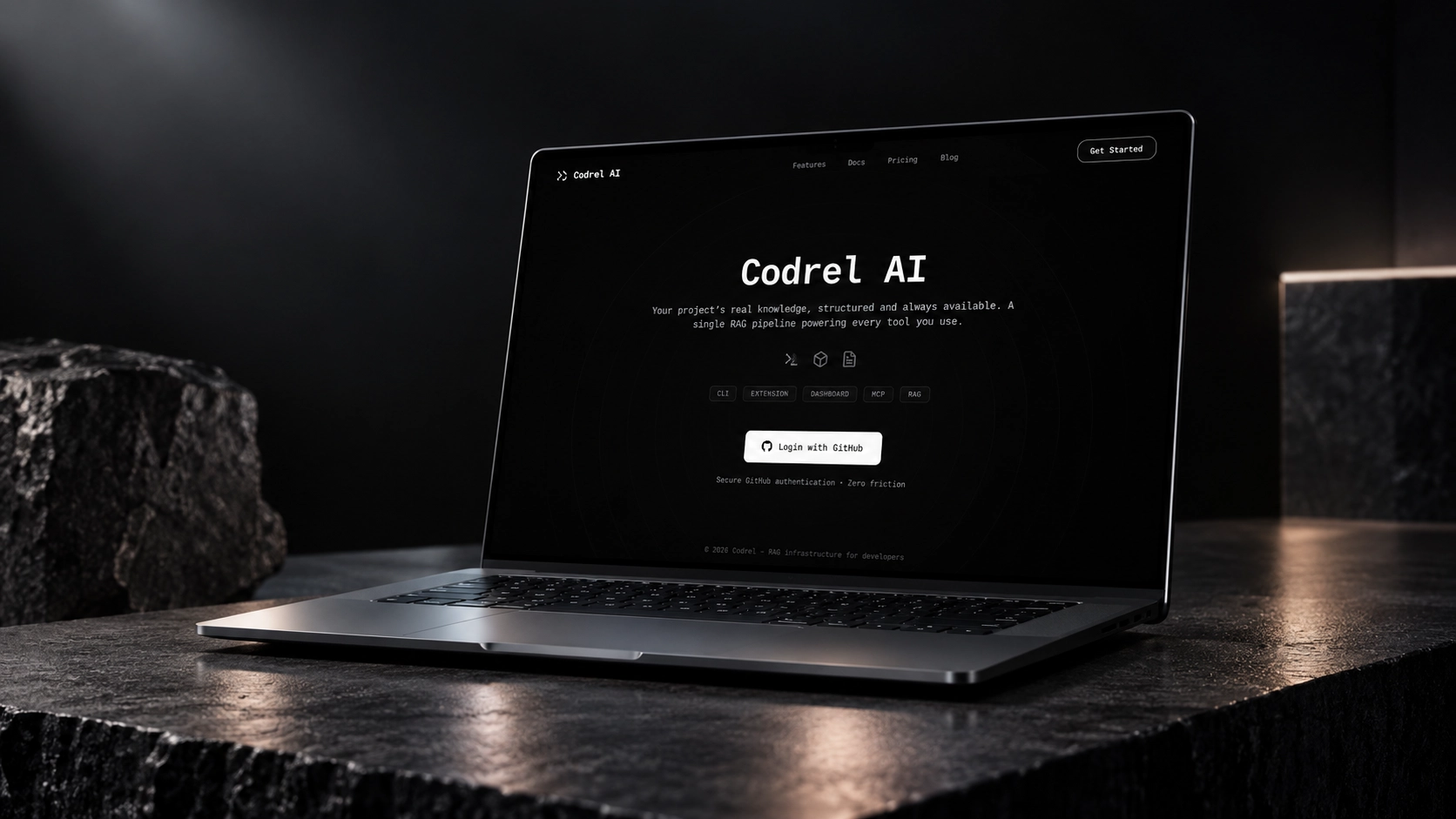
Repository knowledge, available wherever an agent works.
Coding agents are powerful, but they rarely understand a team’s architecture, internal APIs, conventions, and domain logic. Codrel turns that scattered project knowledge into structured context that can be retrieved when an agent needs it.
The product spans ingestion, retrieval, management, and delivery. One shared context pipeline serves a command-line tool, a web dashboard, an MCP server, and IDE extensions.
A complete developer-tooling stack
- Repository and documentation ingestion
- RAG-ready context processing
- Next.js management dashboard
- MCP server for agent access
- IDE extension integration
- Authentication and API delivery
Agents were guessing without system context.
A repository contains the information an agent needs, but the useful context is split across source code, documentation, architecture decisions, and internal conventions. Sending all of it to a model is noisy, expensive, and often less accurate.
The system needed to ingest different sources, structure them consistently, retrieve only what mattered, and expose the result through the tools developers already use.
- 1.
Context scattered across code and docs
- 2.
Full repositories overwhelming prompt windows
- 3.
Agent integrations drifting out of sync
- 4.
Little visibility into the context being used
What We Were Really Solving
This was not only a retrieval problem. It was a shared knowledge and delivery problem.
-
Compress repository knowledge
Turn a large software system into focused context an agent can use.
-
Retrieve only what matters
Reduce noise while preserving the details needed for the current task.
-
Unify every agent surface
Keep the CLI, dashboard, MCP server, and IDE extensions on one source.
-
Give teams operational control
Make projects, access, documents, and usage visible.
One pipeline, four connected surfaces
The architecture separates knowledge processing from the interfaces that consume it, so every agent surface receives the same repository-aware context.
- 01
Ingest
The CLI reads repositories, documentation, and project knowledge into a consistent processing pipeline.
- 02
Structure
Content is normalized, embedded, and prepared for focused retrieval instead of broad prompt stuffing.
- 03
Manage
The dashboard gives teams visibility into projects, indexed documents, usage, and access controls.
- 04
Deliver
MCP, APIs, and IDE extensions place the right context inside an agent’s working loop.
A context engine built as a product
Codrel combines infrastructure and user-facing tools into one coherent developer experience.
- 01
Knowledge ingestion
A command-line workflow turns repository material into structured, reusable project context.
- 02
Context retrieval
A RAG pipeline selects relevant system knowledge for each query and keeps agent responses grounded.
- 03
Operational dashboard
Teams can connect projects, inspect activity, manage tokens, and understand how the context service is being used.
- 04
Agent integrations
MCP and IDE integrations deliver context directly into AI-assisted development workflows.
Product, platform, and integration delivery
AI retrieval system
Embedding and retrieval workflows convert project material into useful agent context.
Developer CLI
A focused ingestion interface fits repository setup into an engineer’s existing workflow.
Web application
The dashboard makes project management, usage, and API access visible to teams.
MCP service
A standard agent interface makes the context layer available across compatible tools.
IDE integration
Extensions bring repository knowledge closer to the point where code is generated.
Deployment architecture
The product is structured as a multi-application system with shared packages and services.
From a model feature to usable infrastructure
Codrel demonstrates the full stack behind an AI developer product: ingestion, data processing, retrieval, APIs, authentication, management UI, and tool integrations.
The result is a working context layer that helps agents reason from project knowledge instead of relying on generic assumptions.
Building a complex product? Let’s make it clear, useful, and shippable.
We design and engineer complex products from strategy through production.